The Ultimate CRM for Manufacturing Unit
Everything You Need to Know in 2026
By Balkrushna Technologies | CRM System
Every manufacturing unit runs on relationships with customers, distributors, field staff, and suppliers. But here’s the reality for most manufacturers: leads get forgotten, follow-ups happen too late, quotations sit unanswered, and nobody really knows where the delivery truck is right now.
Sound familiar?
When your sales team is juggling enquiries on WhatsApp, your field staff is unreachable, and your customer history is buried in a spreadsheet from three months ago you’re not running a business efficiently. You’re firefighting every single day.
That’s exactly where a CRM for manufacturing unit steps in — and in this guide, you’ll learn everything you need to know about choosing and using one effectively.
A CRM for manufacturing unit is not just software — it’s the central nervous system that connects your sales, operations, field team, and customers in one place.
In this guide, you’ll learn what a manufacturing CRM actually is, what features to look for, the real benefits it brings to your unit, and how to choose the right one explained simply, without the tech jargon.
Let’s dive in.
What is a CRM for Manufacturing?
Let’s start simple.
A CRM (Customer Relationship Management) system is a software tool that helps businesses manage their interactions with current and potential customers. It stores customer data, tracks communication, automates follow-ups, and gives your entire team a single, clear view of every deal and relationship.
But here’s the thing a generic CRM is built for everyone. A CRM for manufacturing is built for you.
Manufacturing is not like selling a subscription or running an e-commerce store. Your sales cycles are longer. Your orders are complex. A single client might go through multiple touchpoints an initial enquiry, a site visit, a test drive or demo, a quotation, negotiation, and finally an order before a deal is closed. And even after that, there’s dispatch, delivery, and after-sales service to manage.
A manufacturing CRM understands all of this.
It doesn’t just store contact names and phone numbers. It tracks every enquiry from the moment it comes in, reminds your team when a follow-up is due, generates quotations and invoices, monitors your stock levels, and even keeps a full history of every interaction with every customer so nothing ever falls through the cracks.
In 2026, with competition growing fiercer across every manufacturing segment, managing customer relationships manually is no longer an option. The manufacturers who are winning are the ones with the right systems in place and a good CRM is right at the top of that list.
Why Does a Manufacturing Unit Need a CRM?
If your manufacturing unit is still running on spreadsheets, sticky notes, and WhatsApp groups you’re not alone. Most small and mid-sized manufacturers start that way. But at some point, the cracks start to show.
Here’s what that looks like in real life:
Leads slip through the cracksA potential customer enquires about your product. Someone notes it down. Then a busy week hits, and that follow-up never happens. The lead goes cold and your competitor gets the order. |
No visibility into the sales pipelineYour sales manager has no real-time view of how many enquiries are open, which ones need follow-up today, and which deals are close to closing. Every update requires calling someone or digging through chats. |
Quotations and invoices take too longYour team is manually creating quotations in Word or Excel, sending them over WhatsApp, and then struggling to track whether the customer even opened it. Delays here directly cost you deals. |
Field staff are completely untrackedYou have executives on the ground visiting clients, attending demos, and handling deliveries, but you have no live visibility into where they are or what they’ve done today. |
After-sales service gets neglectedA customer’s machine is due for a service. Nobody remembers. The customer calls to complain. That’s a relationship damaged and a renewal at risk. |
Customer history is scattered everywhereWhen a customer calls with a question or a complaint, your team scrambles to find past orders, previous conversations, and service records across three different apps and two WhatsApp groups. |
A CRM for a manufacturing unit solves every single one of these problems.
It centralizes your inquiries and leads, automates follow-up reminders, tracks your field staff in real time, generates quotations and invoices in seconds, sends service-due alerts automatically, and keeps every customer’s complete history in one place accessible by your entire team, anytime.
Did you know? 86% of manufacturing firms already rely on a CRM to centralize contacts, sales pipelines, and service cases. |
The question is no longer “do we need a CRM?” it’s “why haven’t we set one up yet?”
Key Features to Look for in a Manufacturing CRM
Not all CRMs are built the same. A CRM designed for a SaaS company will feel completely out of place in a manufacturing environment. So when you’re evaluating a CRM for your manufacturing unit, here are the key features you should absolutely look for.
Sales Enquiry & Lead Management
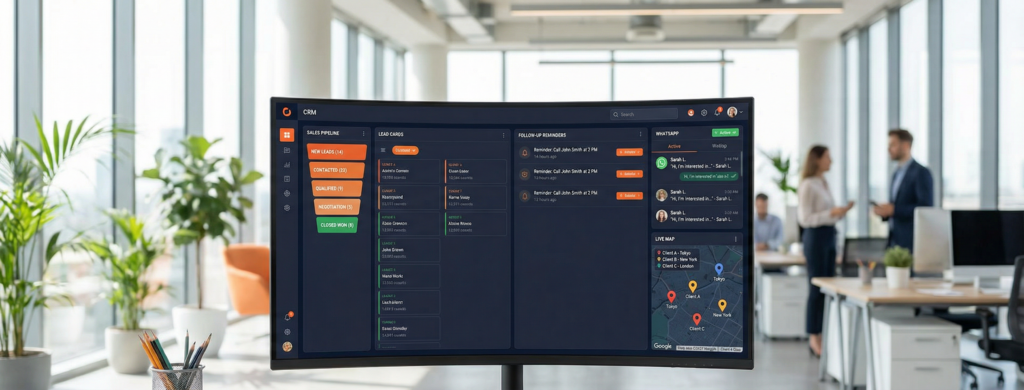
Every sale starts with an enquiry. A good manufacturing CRM captures every lead whether it comes in through a phone call, WhatsApp message, website form, or a field visit and logs it in one central place. No more missed leads, no more “I thought you were handling it” conversations.
Your team gets a clear view of every open enquiry, its current status, and who is responsible for it.
Follow-Up & Test Drive Tracking
Manufacturing sales cycles are long. A customer might enquire today and take three weeks to decide. During that time, consistent follow-ups make all the difference.
A manufacturing CRM automatically reminds your team when a follow-up is due whether it’s a call, a site visit, or a product demo or test drive. No lead goes cold because someone forgot to follow up.
Quotation & Invoice Generation
Sending quotations manually through Word documents or WhatsApp is slow and unprofessional. A CRM built for manufacturing lets your team generate accurate quotations and invoices directly from the system in minutes, not hours.
This speeds up the sales cycle, reduces errors, and gives customers a more professional experience from day one.
Stock & Inventory Management
Your sales team needs to know what’s available before they make a promise to a customer. A manufacturing CRM with built-in stock and inventory management gives real-time visibility into available units so your team never oversells, and customers never face unexpected delays.
Dispatch & Delivery Tracking
Once an order is confirmed, the job isn’t done. Your customer wants to know when their order is arriving and your team needs to manage that efficiently.
A CRM with dispatch and delivery tracking keeps everything organised from order confirmation to the moment it reaches the customer’s door so nothing gets lost in transit and no customer is left wondering.
Service & Service-Due Reminders
After-sales service is where long-term customer relationships are built or broken. A manufacturing CRM automatically tracks service schedules and sends timely reminders to both your team and your customers before a service is due.
This means fewer missed services, happier customers, and more repeat business.
Customer History Tracking
Every interaction with a customer every call, enquiry, quotation, order, delivery, and service should be recorded and easily accessible. A CRM that maintains a complete customer history means your team always knows the full picture before picking up the phone.
No more asking the customer to repeat themselves. No more confusion about what was promised.
Employee Task Management
A manufacturing unit has a lot of moving parts and a lot of people managing them. A CRM with employee task management lets managers assign tasks, set deadlines, and track completion all from one dashboard.
Your team stays accountable, your managers stay informed, and nothing falls through the cracks.
Field Staff Live Location Tracking
If you have executives or delivery personnel out in the field, you need real-time visibility. A CRM with live location tracking lets you see exactly where your field staff are at any given moment helping you coordinate better, respond faster, and ensure client visits are actually happening.
Bulk WhatsApp Messaging
WhatsApp is where your customers are. A manufacturing CRM with bulk WhatsApp messaging lets you send offers, reminders, follow-ups, and service alerts to hundreds of customers at once personalised, timely, and without manual effort.
Whether it’s a new product launch, a festive offer, or a service-due reminder your message reaches the right customer at the right time.
Top Benefits of CRM for a Manufacturing Unit
Now that you know what features to look for, let’s talk about what actually changes when you bring a CRM into your manufacturing unit. Because features are just tools what matters is the real-world impact they create.
Here’s what you can expect:
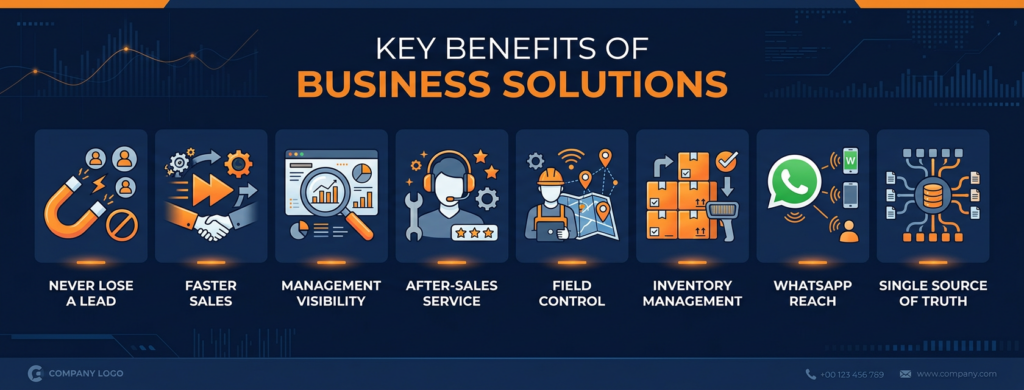
Never Lose a Lead Again
Every enquiry that comes into your unit has value. A CRM ensures that every single lead no matter where it comes from is captured, assigned, and followed up on time. No more leads dying in WhatsApp chats or forgotten in someone’s notebook.
The result? More conversions from the same number of enquiries you’re already getting.
Faster, More Professional Sales Process
From the moment a customer enquires to the moment they receive their invoice, a CRM speeds everything up. Quotations are generated in minutes. Follow-ups happen automatically. And your customer gets a smooth, professional experience that builds confidence in your brand.
In a competitive market, that professionalism alone can be the reason a customer chooses you over someone else.
Complete Visibility for Management
As a business owner or sales manager, you shouldn’t have to call five people to understand what’s happening in your pipeline today. A CRM gives you a real-time dashboard open enquiries, pending follow-ups, quotations sent, orders confirmed, deliveries in progress all in one place.
You make better decisions when you have better information.
Stronger After-Sales Relationships
The sale doesn’t end at delivery. Service-due reminders, follow-up calls, and personalised WhatsApp messages keep your customers engaged long after the purchase. This builds loyalty, drives repeat orders, and turns one-time buyers into long-term clients.
It’s far cheaper to retain an existing customer than to find a new one and a CRM makes retention effortless.
Full Control Over Field Operations
With live location tracking and task management built into your CRM, you always know what your field staff are doing, where they are, and what’s been completed. This improves accountability, reduces idle time, and ensures your customers are getting the visits and service they were promised.
Smarter Inventory & Dispatch Management
When your sales team has real-time visibility into stock levels, they make better promises to customers. When dispatch is tracked inside the CRM, everyone from the warehouse to the customer knows exactly where an order stands.
No more overpromising. No more last-minute surprises on delivery day.
Reach Customers at Scale with WhatsApp
With bulk WhatsApp messaging, you can instantly reach your entire customer base with offers, reminders, and updates without spending hours doing it manually. Whether it’s a festive discount, a new product launch, or a service reminder your message goes out to the right people at the right time.
This kind of direct, personalised communication drives enquiries, repeat purchases, and referrals.
One Source of Truth for Your Entire Team
When everyone sales, operations, field staff, management is working from the same system, miscommunication drops dramatically. No more “I didn’t know that” or “nobody told me.” The CRM becomes the single source of truth that keeps your entire unit aligned and moving in the same direction.
|
Quick stat: Businesses that use a CRM effectively report up to a 29% increase in sales, a 34% boost in team productivity, and a 42% improvement in forecast accuracy. For a manufacturing unit, those numbers translate directly to more orders, faster operations, and happier customers. |
CRM vs ERP What’s the Difference & Do You Need Both?
If you’ve been researching software solutions for your manufacturing unit, chances are you’ve come across two terms repeatedly CRM and ERP. And if you’re wondering whether they’re the same thing, or which one you actually need, you’re not alone. It’s one of the most common questions manufacturers ask.
Let’s break it down simply.
What is a CRM?
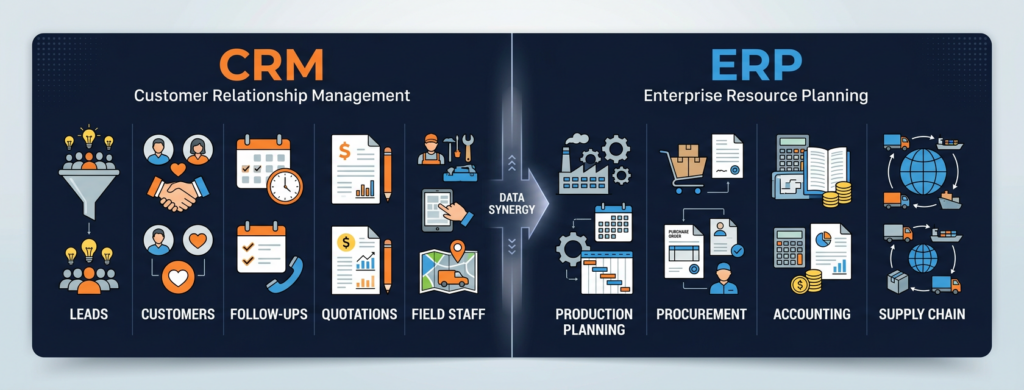
A CRM Customer Relationship Management system focuses on everything that happens outside your factory walls. It manages your leads, customer interactions, follow-ups, quotations, field staff, service reminders, and communication. In short, it handles the customer-facing side of your business.
If your question is “what’s happening with my customers?” that’s a CRM answering it.
What is an ERP?
An ERP Enterprise Resource Planning system focuses on everything that happens inside your operations. It manages production planning, raw materials, accounting, payroll, procurement, and supply chain. In short, it handles the internal side of your business.
If your question is “what’s happening inside my factory?” that’s an ERP answering it.
So do they compete with each other?
Not at all. They’re actually designed to work together.
Think of it this way your CRM tells you that a big order is about to close. Your ERP uses that information to plan production, allocate raw materials, and schedule delivery. One feeds the other. When both systems are connected, your entire business runs smoother from the first customer enquiry all the way to the final delivery.
Which one should you start with?
For most small and mid-sized manufacturing units, a CRM is the better first investment. Here’s why your revenue depends on customers. And before you can optimise your internal operations, you need a steady, well-managed flow of orders coming in.
A CRM fixes the customer-facing gaps first missed leads, delayed follow-ups, poor after-sales service which directly impacts your top line. Once your sales engine is running smoothly, an ERP helps you scale the operations behind it.
That said, if your manufacturing unit is already at a scale where production planning and procurement are becoming complex, running both in parallel or choosing a solution that offers CRM features alongside basic inventory and dispatch management is the smarter move.
How to Choose the Right CRM for Your Manufacturing Unit
With so many CRM options available in 2026, choosing the right one can feel overwhelming. Every product claims to be the best. Every demo looks impressive. But not every CRM is actually built for the realities of a manufacturing unit.
Here’s a practical checklist to help you cut through the noise and make the right decision.
1. Is it built for manufacturing or just adapted for it?
There’s a big difference between a CRM that was designed with manufacturing in mind and a generic CRM that’s been tweaked to fit. A manufacturing-specific CRM will have features like enquiry tracking, test drive or demo management, service-due reminders, dispatch tracking, and field staff management built right in not bolted on as an afterthought.
If you have to heavily customise a CRM just to make it work for your unit, it’s probably not the right fit.
2. Does it cover the full customer journey?
Your CRM should follow the customer from the very first enquiry all the way through to after-sales service. That means lead capture, follow-ups, quotation generation, order management, dispatch tracking, delivery confirmation, and service reminders all inside one system.
If it only handles the sales side and nothing beyond, you’ll end up stitching together multiple tools which defeats the purpose.
3. Is it easy enough for your whole team to use?
A CRM is only as good as the people using it. If it’s too complex, your team won’t adopt it and you’ll be back to WhatsApp groups and spreadsheets within a month.
Look for a CRM with a clean, simple interface that your sales team, field staff, and management can all use comfortably without needing weeks of training.
4. Does it support WhatsApp communication?
In India especially, WhatsApp is the primary channel of business communication. A CRM that supports bulk WhatsApp messaging for follow-ups, offers, reminders, and service alerts is not a nice-to-have anymore. It’s essential.
If your CRM can’t communicate where your customers actually are, it’s already working at a disadvantage.
5. Does it give management real-time visibility?
As a business owner or manager, you need a live view of what’s happening right now. Open leads, pending follow-ups, field staff locations, stock levels, dispatch status. If you have to wait for a morning report or call someone to get an update, the CRM isn’t doing its job.
Look for a system with a real-time dashboard that puts everything in front of you instantly.
6. Is it scalable as your business grows?
Your manufacturing unit today might have 5 salespeople. Two years from now, it might have 25. The CRM you choose should be able to grow with you handling more users, more data, more locations, and more complexity without needing a full replacement.
Always think about where your business is going, not just where it is today.
7. What is the total cost of ownership?
Don’t just look at the monthly subscription price. Factor in setup costs, training time, data migration, and ongoing support. A CRM that’s slightly more expensive but comes with dedicated onboarding and local support is often far better value than a cheaper tool that leaves you figuring things out on your own.
Also if you’re a manufacturing unit based in India, choosing a CRM built and supported locally means faster response times, better understanding of your market, and communication in your language when you need help.
Frequently Asked Questions
Q1. What is a CRM for manufacturing?A CRM for manufacturing is a software system designed to help manufacturing units manage their customer relationships, sales processes, and after-sales operations in one place. Unlike generic CRM tools, a manufacturing CRM includes features specifically suited to the industry such as lead and enquiry management, quotation generation, dispatch tracking, service reminders, and field staff management. |
Q2. How does a CRM help manufacturing companies increase sales?A CRM increases sales by ensuring no lead is missed, every follow-up happens on time, and quotations reach customers quickly. It gives your sales team a clear view of the entire pipeline so they know exactly which leads to prioritise and when to act. Over time, faster response times and consistent follow-ups directly translate into more closed deals. |
Q3. Is a CRM different from an ERP in manufacturing?Yes. A CRM focuses on the customer-facing side of your business leads, sales, communication, service, and field operations. An ERP focuses on internal operations production planning, procurement, accounting, and supply chain. Both serve different purposes, and many manufacturing units benefit from using them together. If you are just starting out, a CRM is usually the better first investment. |
Q4. Can small manufacturing units benefit from a CRM?Absolutely. In fact, small and mid-sized manufacturing units often benefit the most from a CRM because they are running lean teams where missed leads and poor follow-ups have an immediate impact on revenue. A CRM brings structure and accountability to a small team without adding complexity and it grows with the business as operations expand. |
Q5. Which is the best CRM for manufacturing companies in 2026?The best CRM for a manufacturing unit is the one that fits your specific workflow not the most popular one or the most expensive one. Look for a system that covers the full customer journey, supports WhatsApp communication, offers real-time visibility for management, tracks field staff, and is easy for your team to adopt. For manufacturing units in India, a locally built and supported CRM that understands the ground realities of the market is often the most practical and effective choice. |
Q6. Can a CRM reduce costs in a manufacturing unit?Yes, in several ways. A CRM reduces the cost of missed opportunities by ensuring leads are followed up on time. It cuts down on manual effort through automation reducing time spent on creating quotations, sending reminders, and updating records. It also improves field staff efficiency through task management and live tracking, which means less time wasted and more productive client visits. Over time, these savings add up significantly. |

Conclusion
Managing a manufacturing unit is no small feat. You are handling leads, following up with customers, coordinating field staff, tracking deliveries, managing stock, and making sure after-sales service does not fall through the cracks all at the same time.
A CRM does not eliminate that complexity. But it does give you the tools to handle it with far more control, visibility, and efficiency than you could ever achieve with spreadsheets and WhatsApp groups alone.
To quickly recap what we covered:
A CRM for manufacturing unit centralises your entire customer journey from the first enquiry to the final service reminder. It automates follow-ups so no lead goes cold. It generates quotations and invoices in minutes. It tracks your field staff in real time. It keeps your entire team aligned on one platform. And it communicates with your customers through the channels they actually use.
In 2026, this is not a luxury for large enterprises. It is a practical necessity for any manufacturing unit that wants to grow consistently, retain customers, and stay ahead of the competition.
The manufacturers who invest in the right systems today are the ones who will be scaling confidently tomorrow.
|
Ready to bring this kind of control to your manufacturing unit? CRM System by Balkrushna Technologies is built specifically for manufacturing businesses like yours. From sales enquiries and follow-ups to dispatch tracking, service reminders, and bulk WhatsApp messaging everything your unit needs is in one place, simple to use, and ready to go. Get in touch with the Balkrushna Technologies team today and see how CRM System can transform the way your manufacturing unit operates. |
Related posts
-
The Ultimate CRM for Manufacturing Unit
Everything You Need to Know in 2026By Balkrushna Technologies | CRM System Every manufacturing unit runs on relationships...
2 April 202612Likes